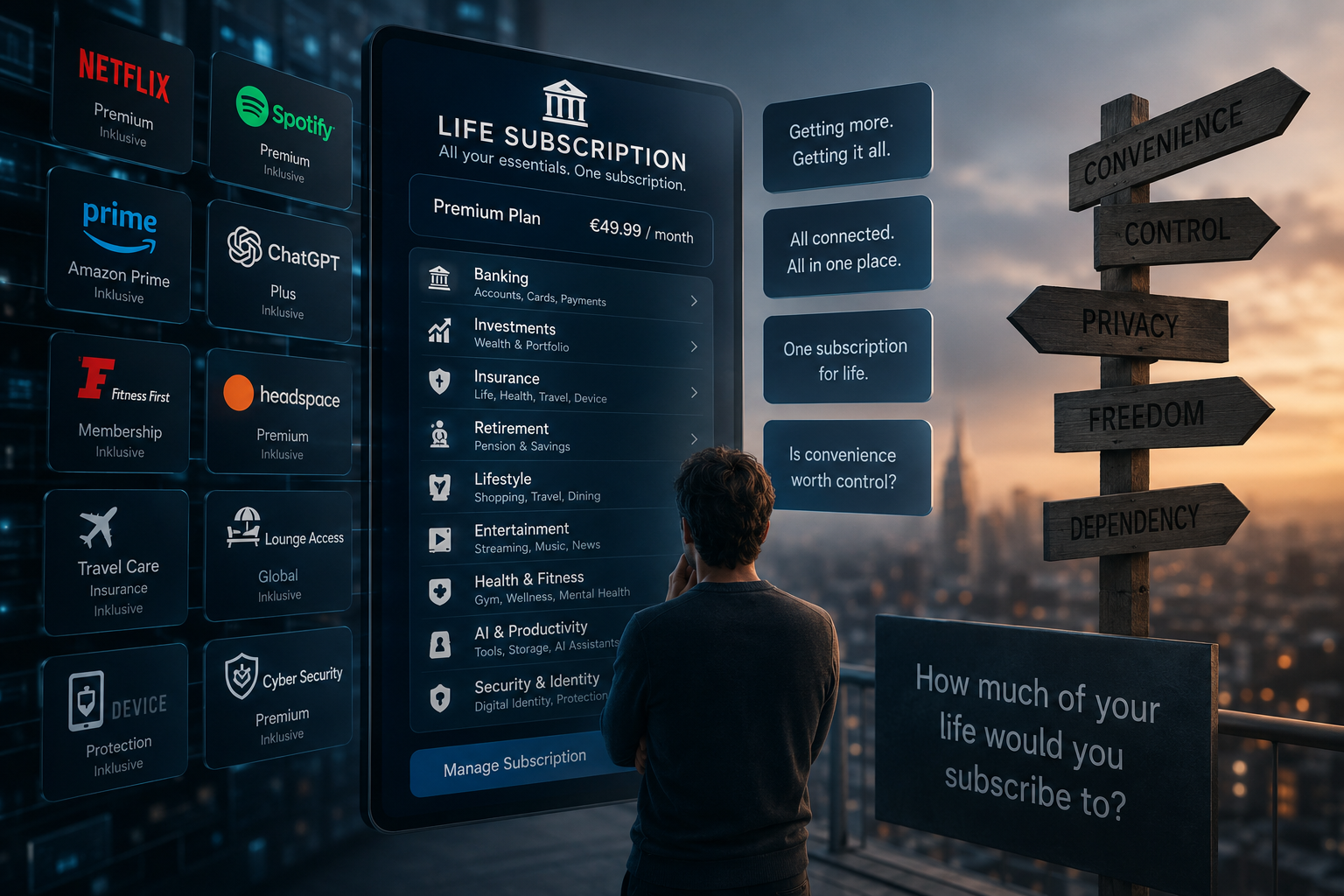
How Much of Your Life Would You Subscribe To?
A few years ago, we used to joke about how absurd the subscription economy had become: Netflix. Spotify. Amazon Prime. Gym memberships. Cloud storage. Software. Phone plans. Meal boxes. News services. There seemed to be a monthly payment for almost everything.
And, at some point, the joke usually ended with the same thought:
“Wouldn’t it be great if someone just bundled everything together?”
One monthly payment. One subscription. One place. It sounded convenient. Perhaps even a little ridiculous. It turns out that idea may not have been so ridiculous after all.
Because increasingly, the company that wants to bundle our subscriptions isn’t a streaming platform or a technology company.
It might be our bank.
From Bank Account to Subscription
Banking subscriptions themselves are nothing new. Premium current accounts, monthly fees, travel benefits, insurance packages and preferential services have existed for years.
What is changing is the breadth of what banks are beginning to put inside those packages.
Across markets, banks and fintechs are increasingly experimenting with subscription models that combine traditional financial services with benefits that extend well beyond banking: travel services, insurance, investment products, lifestyle benefits and third party subscriptions.
The individual components aren’t particularly revolutionary, The combination is.
The bank account is slowly becoming less of a product and more of a platform.
And that distinction matters.
For most of modern banking history, the relationship between a customer and a bank was relatively straightforward. The bank held your money, provided a payment mechanism, lent you money when required and perhaps offered some savings or investment products.
Today, the ambition has become considerably broader.
The bank wants to become the place where you manage not only your money, but increasingly the services and decisions surrounding your life.
The Bank of Everything
Consider what a premium banking subscription could eventually look like.
Your monthly fee might cover the current account and credit card, but also travel insurance, airport lounge access, investment services, a gym membership, streaming services, an AI subscription, device insurance or preferential conditions on a mortgage.
Individually, none of these services is particularly surprising.
Together, they represent something fundamentally different.
You are no longer simply paying for a bank account.
You are paying for an ecosystem of services organised around your life.
This is the natural evolution of a business model that technology companies have been perfecting for years. The objective isn’t necessarily to provide every service yourself. It is to become the place through which customers access those services.
The bank doesn’t have to own Netflix, a gym chain or an insurance company.
It simply needs to become the interface through which you pay for, access or manage them.
And once it occupies that position, the value of the relationship changes considerably.
From Managing Money to Managing Your Financial Life
There is an even more important shift taking place underneath the subscription model.
Banks are moving further into areas of our financial lives that historically sat outside the everyday banking relationship: Investments, Insurance, Wealth management, Long term savings and Retirement.
Germany’s upcoming Altersvorsorgedepot is an interesting example of how this relationship could develop further. Retirement investing is no longer simply something customers might arrange with a separate specialist provider. It is increasingly becoming part of the broader financial relationship they have with their bank.
The question therefore changes.
It is no longer simply, “Where do I keep my money?”, instead, It becomes: “Where do I manage my financial future?”. That is a much more consequential relationship.
And if the same institution manages your everyday finances, investments, insurance, credit and retirement, the bank account becomes something considerably more significant than a payment account.
It becomes the financial operating system of your life.
The Convenience Argument Is Hard to Ignore
There is a very good reason this model is emerging.
Consumers are tired of managing complexity.
Every additional service means another contract, another payment, another password, another renewal date and another company that needs access to our data.
Bundling can genuinely solve that problem.
If one subscription gives you services you already use, at a price that is lower than purchasing them individually, there is obvious value.
It can reduce administrative effort. It can simplify the customer experience. It can make financial services more accessible. And, if the underlying products are properly integrated, it can create experiences that individual providers cannot easily replicate.
There is nothing inherently wrong with that. In fact, it may be one of the most logical developments in consumer finance. But convenience has an interesting side effect.
The more useful the bundle becomes, the harder it becomes to leave.
The Cost of Switching
Cancelling Netflix is easy.
Changing your bank is not.
And the difference becomes even more significant when the bank relationship includes your investments, insurance policies, credit facilities, retirement savings and a growing collection of lifestyle services.
Switching providers doesn’t simply mean opening another current account. It means untangling a relationship that has gradually become embedded in different parts of your life.
This creates a form of customer loyalty that is very different from traditional loyalty.
You may not stay because you particularly love your bank.
You stay because leaving has become inconvenient.
That distinction is important.
The strongest ecosystems aren’t necessarily the ones customers love and trust the most. They are often the ones that make switching sufficiently difficult that customers don’t bother.
Technology companies have understood this for years.
Banking may be entering the same territory.
From Products to Ecosystems
This also changes the way customers make decisions. When banking products were largely independent, comparison was relatively straightforward.
- Which account has the lowest fee?
- Which card has the best benefits?
- Which savings account pays the highest interest?
- Which insurer offers the best coverage?
But when everything becomes bundled, the comparison becomes much harder.
You are no longer comparing products.
You are comparing ecosystems.
A bank might be more expensive for its current account but include services that would otherwise cost €50 a month. Another might offer better investment products but fewer lifestyle benefits. A third might provide better travel benefits.
Suddenly, the question isn’t “Which product is best?”
It is: “Which ecosystem fits my life best?”
That is a much more powerful position for the provider.
The Subscription Arms Race
And once one institution starts bundling services successfully, competitors have a reason to follow: One bank adds travel insurance, another adds airport lounge access, someone else adds a streaming service. Then fitness. Then AI. Then financial advice. Then exclusive experiences.
The subscription becomes a competitive battlefield, not just between banks, but between banks and the entire ecosystem of companies competing for a share of the customer’s monthly spending. At some point, the distinction between financial services and lifestyle services begins to disappear.
And that is where things get genuinely interesting.
Because the bank isn’t simply competing to manage your money anymore.
It is competing to become the default relationship through which you organise your life.
The Question Nobody Is Really Asking
The obvious question is whether these subscriptions are good value.
But I think there is a more important question: What happens when the subscription becomes the infrastructure of your life?
From a consumer perspective, consolidation sounds simple. One provider, one payment, one interface.
From a technology perspective, it is anything but simple.
Behind the scenes, every additional service introduces another integration, another data exchange, another dependency and another potential point of failure.
Your bank may need to connect to insurers, investment platforms, travel providers, gyms, streaming services, identity providers and countless other partners.
The more services that become connected, the more important the underlying architecture becomes.
- What happens when one of those partners goes down?
- What happens when an API changes?
- What happens when a third party is compromised?
- What happens when the provider that sits in the middle of all these relationships becomes unavailable?
We have spent years talking about avoiding single points of failure in technology.
Yet the more services we consolidate into one financial ecosystem, the more we risk creating exactly that at a consumer level.
There is another question that is even more uncomfortable.
Who owns the relationship with the customer?
If your bank becomes the gateway to your insurance, investments, travel, entertainment and other services, it potentially gains an extraordinarily detailed picture of your life: Where you travel, What you buy, What you insure, Where you invest, What you subscribe to and perhaps even how you identify yourself across different services.
That creates questions about data sovereignty, consent and control that go far beyond traditional banking.
And this is where technology architecture, regulation and customer experience start to collide.
The European Digital Identity Wallet, or EUDI Wallet, could add another layer to this development. As digital identity becomes more portable and interoperable across services, customers may increasingly be able to prove who they are, share verified information and access services across organisational boundaries without repeatedly establishing their identity from scratch.
That could make these ecosystems significantly easier to build.
It could also make them significantly more powerful.
The technical challenge is therefore no longer simply how to integrate another service. It becomes how to design an ecosystem that remains secure, resilient, interoperable and genuinely under the customer’s control. For technology leaders, that is a very different problem from adding another feature to a banking app.
It is an architecture problem.
And potentially a very large one.
The Life Subscription
Perhaps the banking subscription is simply the next logical step in a much larger trend.
We have spent the last decade moving from owning products to subscribing to services.
Now we may be moving from subscribing to individual services to subscribing to bundled ecosystems.
And banks are unusually well positioned to take advantage of that shift.
They already have the relationship.
They already have the payment infrastructure.
They already have visibility into our financial behaviour.
And increasingly, they have the products, partnerships and technology to extend that relationship into other areas of our lives.
The result could be something that looks very different from the bank account we grew up with.
Not a place where you simply store and move money, but a subscription that connects your financial life with the services you use every day.
A life subscription, in everything but name.
So, Where Do We Draw the Line?
For years, we complained about having too many subscriptions.
Now the market is offering us the opposite: one subscription that could potentially cover almost everything.
Maybe that is exactly what consumers want.
There is a strong argument that simplifying dozens of fragmented relationships into one integrated experience could make life easier, cheaper and more transparent.
But there is another possibility.
Perhaps we aren’t eliminating complexity.
Perhaps we’re simply consolidating it.
The difference matters.
Because if your bank eventually manages your money, insurance, investments, retirement, travel, entertainment and everyday services, changing banks no longer means changing a bank account.
It means changing part of your life.
And that leaves us with a question that the banking industry may be very happy to answer for us:
How much of our life are we actually willing to subscribe to?
Authors

Related Posts

Local MCP Servers: Understanding Attack Scenarios and Security Gaps
Tool poisoning, rug pulls and prompt injection against local MCP servers: how these attacks really work.

The End of “Digital Transformation” Buzzwords
Why execution, not technology, is the real driver of business transformation.

BCE Pattern in a Monolith: Clean Architecture for Complex Systems
A practical introduction to the Boundary-Control-Entity pattern, which makes monoliths more modular, maintainable, and better prepared for future evolution.